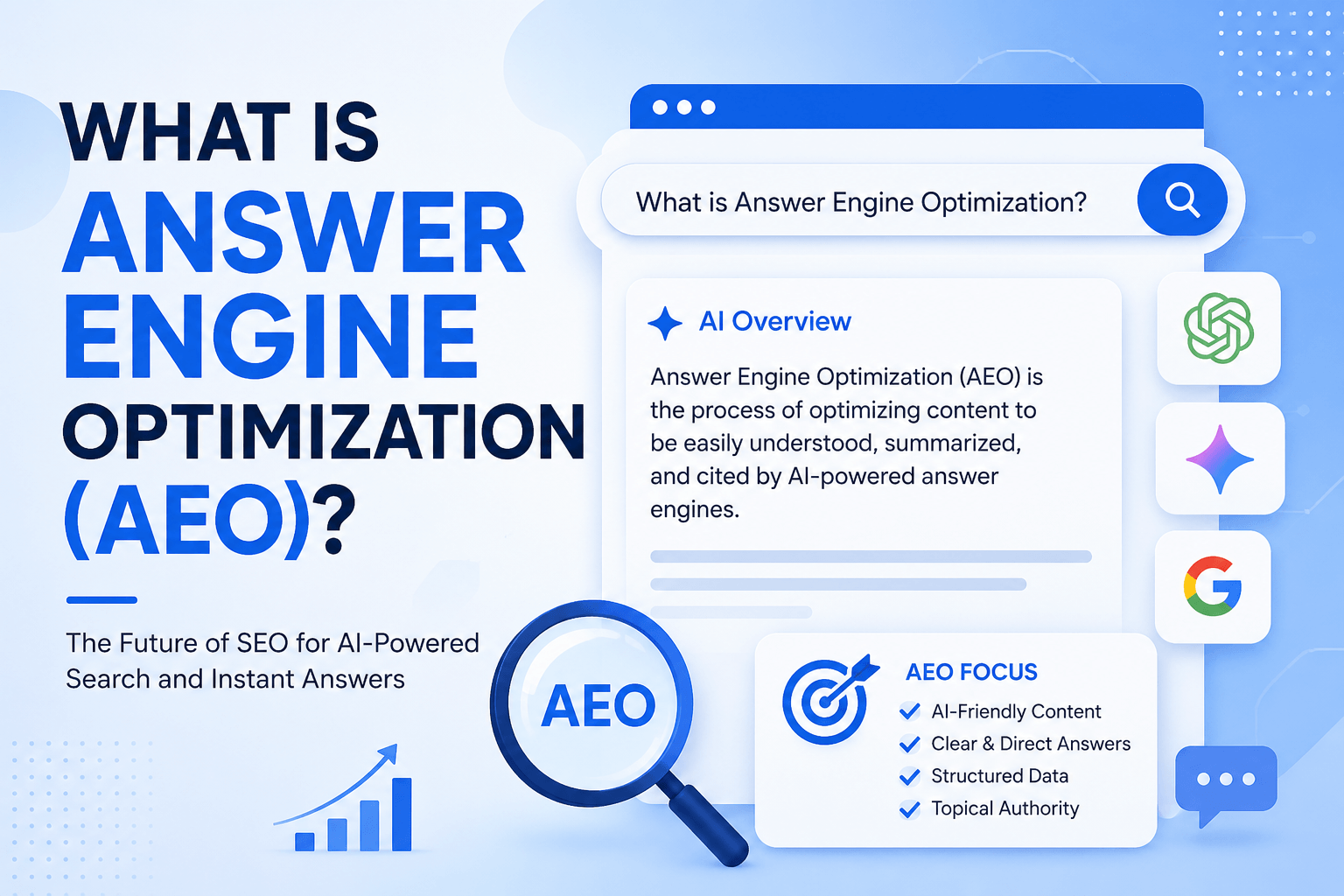
What is Answer Engine Optimization (AEO)?
What is Traditional SEO & AEO?
Traditional SEO:
Search Engine Optimization (SEO) is the practice of improving a website so it ranks higher on search engine results pages (SERPs) like Google or Bing. The goal is to drive organic traffic — people clicking your blue link after a keyword search.
SEO works through three pillars: technical health (fast, crawlable site), on-page content (keyword-rich, well-structured pages), and authority (backlinks from trusted sites). A high-ranking SEO result means visibility — but the user still has to choose to click on your link.
Answer Engine Optimization (AEO):
Answer Engine Optimization (AEO) is the practice of structuring your content so that AI-powered answer engines — Google AI Overviews, ChatGPT, Bing Copilot, Perplexity, Siri, Alexa — can extract and deliver your information directly as the answer to a user’s question.
With AEO, the “click” is secondary. Your brand’s knowledge, authority, and expertise become the answer itself. The user may never visit your website, but they receive your information, trust your brand, and remember your name.
Why It’s Really Important to Brand Your Business
AEO is not just a technical tweak — it is a strategic branding lever. Here is why it matters deeply for your business in 2025 and beyond.
1. AI is the New First Impression
When someone asks “What is the best digital marketing agency in Chennai?” to Google AI or ChatGPT, the answer they receive is their first impression of the market. If your brand is cited in that answer, you win authority before the user has visited any website. If you are absent, you are invisible — even if you rank #2 on traditional search.
2. Zero-Click Searches Are the New Normal
Research shows that a growing share of searches end without a click. Users get the answer they need directly from the search page or AI tool. For brands that rely solely on SEO traffic, this trend is a quiet threat. For brands that invest in AEO, it is an opportunity — because now your information reaches users at the exact moment of need, without friction.
3. Voice Search Is Exploding
Smart speakers, mobile voice assistants, and in-car AI are becoming primary search surfaces. Voice results are almost always a single answer — not a list of ten blue links. AEO is the discipline that gets your brand into that one answer slot. For local businesses especially, this is transformational.
4. Trust and Authority at Scale
AI engines like Perplexity and ChatGPT pull answers from sources they consider authoritative, well-structured, and trustworthy. When your brand is consistently cited, users begin to associate your business with reliable expertise in your field — building brand equity that no paid ad can replicate.
“In the AI-first era, showing up is not about ranking — it is about being the answer.”
5. Competitive Differentiation
Most businesses are still focused exclusively on traditional SEO. Early investment in AEO puts your brand ahead of competitors who have not yet adapted. The window to establish authority in AI systems is open right now — and early movers gain compounding advantages as AI engines learn which sources to trust.
How to Effectively Integrate AEO & SEO
AEO and SEO are not opposites — they are complementary strategies. The strongest digital presence combines both. Here is how to integrate them effectively:
1. Build a Strong Technical Foundation (SEO First) — AEO cannot work on a broken website. Ensure fast load speeds, mobile responsiveness, clean URL structure, and proper indexing. Technical SEO is the soil; AEO is the crop.
2. Create Question-Led Content — Identify the exact questions your audience asks. Use tools like Google’s “People Also Ask”, AnswerThePublic, or Semrush. Write content that directly answers each question in clear, concise language — ideally within the first 40–60 words of a section.
3. Implement Structured Data (Schema Markup) — Add FAQ Schema, HowTo Schema, and Article Schema to your pages. This tells Google and AI engines exactly what type of content you have, dramatically improving the chance your content is selected for featured snippets and AI answers.
4. Optimize for Featured Snippets — Featured snippets (position zero on Google) are the bridge between SEO and AEO. Target question-based keywords, format answers as short paragraphs or concise bullet lists, and use clear headings. AI systems heavily draw from featured snippet content.
5. Build E-E-A-T (Experience, Expertise, Authoritativeness, Trustworthiness) — Google’s quality guidelines and AI systems both reward content from credible, knowledgeable sources. Include author bios, cite sources, earn backlinks from respected sites, and keep content accurate and up to date.
6. Optimize for Conversational & Long-Tail Queries — AI searches tend to be phrased as natural questions (“How do I reduce my tax bill as a freelancer?”) rather than keyword fragments (“tax tips freelancer”). Write content that mirrors natural language and addresses the full intent behind a question.
7. Leverage Local & Voice Search Optimization — Ensure your Google Business Profile is complete and accurate. Use location-specific FAQ content. Include natural language phrases like “near me” and “in [city]” to capture voice queries that AI assistants use for local recommendations.
8. Monitor AI Citations & Adjust — Regularly test how AI tools answer questions in your niche. Search your target questions on ChatGPT, Perplexity, and Google AI Overviews. Note which sources are cited. If competitors appear and you don’t, analyze their content structure and adapt yours accordingly.
What Are the Major Differences Between AEO & SEO
Understanding the distinctions helps you allocate effort intelligently. Neither strategy replaces the other — but each has a distinct focus.
| Aspect | Traditional SEO | AEO (Answer Engine Optimization) |
|---|---|---|
| Primary target | Search engine ranking algorithms | AI answer engines & voice assistants |
| Main goal | Rank #1 and earn the click | Become the direct answer |
| Content structure | Keyword-focused pages and articles | Question-and-answer focused content |
| Success metric | Website traffic and clicks | Brand authority, citations, and visibility in AI answers |
| User journey | User searches → clicks link → reads page | User asks → AI answers using your content |
| Optimization focus | Keywords, backlinks, technical SEO | Clear answers, structured data, entity recognition, trust signals |
| Typical format | Long-form blog posts and landing pages | FAQs, concise definitions, step-by-step answers |
| Visibility channel | Google/Bing search results | ChatGPT, Google AI Overviews, voice assistants, AI search tools |
| Traffic expectation | High click-through potential | May provide fewer clicks but stronger brand exposure |
| Best use case | Driving visitors to a website | Becoming a trusted source that AI systems reference |
The takeaway: SEO gets you on the map. AEO makes you the destination. Businesses that invest in both build a resilient, multi-surface digital presence that captures users whether they search traditionally or ask an AI assistant.
Final Thoughts
The shift from search engines to answer engines is not a future trend — it is happening right now. Every time a user asks Google AI “What CRM is best for small businesses?” or asks Siri “Who is the best dentist near me?” — a brand wins or loses visibility based entirely on how well their content is optimized for AEO.
The good news: AEO does not require a complete overhaul of your strategy. It requires a shift in thinking — from “How do I rank for this keyword?” to “How do I become the clearest, most trustworthy answer to this question?”
The business owners, this means investing in quality content that genuinely serves your audience. For marketers, it means learning schema markup, studying featured snippets, and monitoring how AI tools perceive your brand. It means expanding your toolkit to include AEO alongside the technical and link-building work you already do.
The brands that thrive in the next decade will be those that appear everywhere their customers look — in search results, in AI answers, in voice responses. Start building for that world today.
